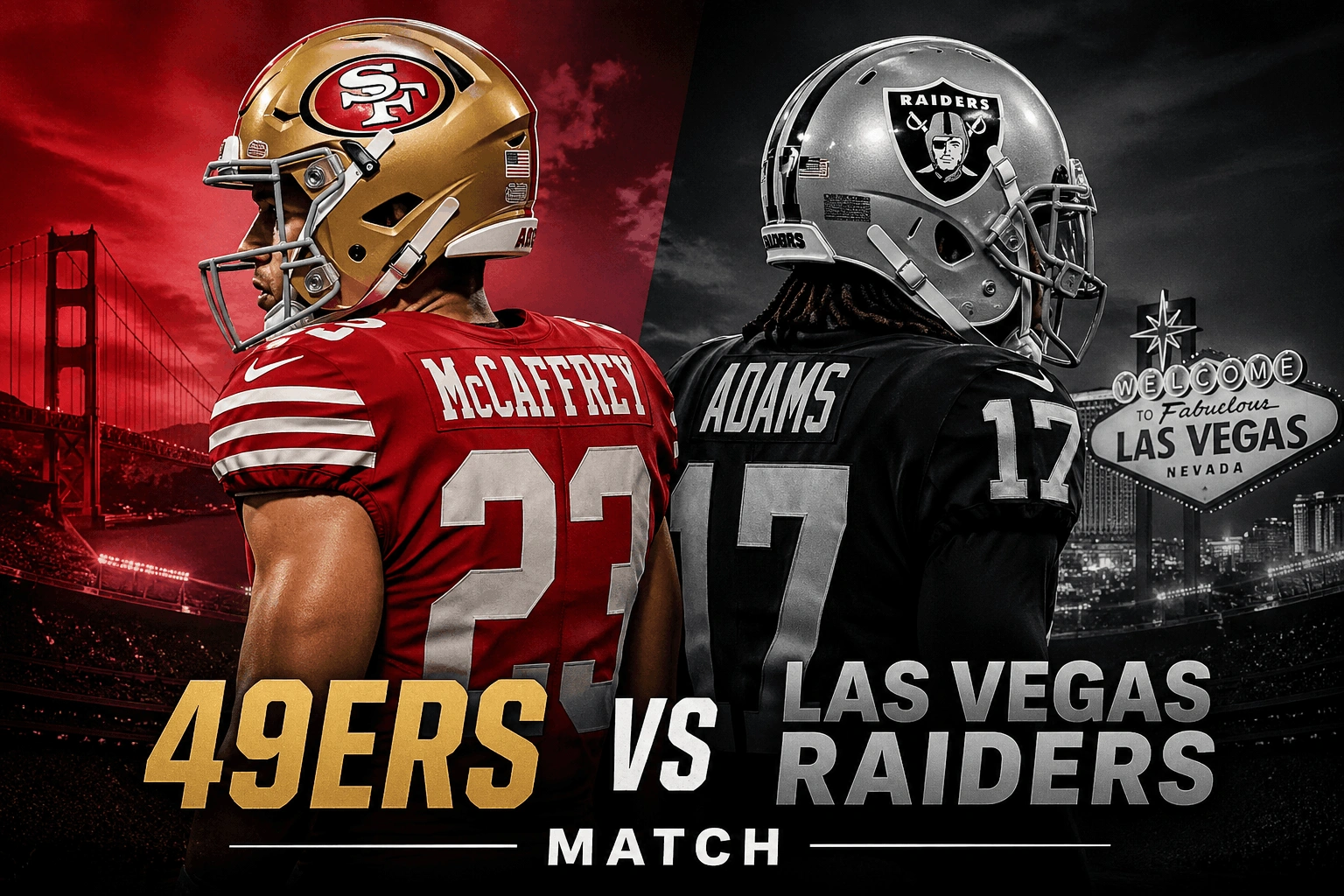
49ers vs Las Vegas Raiders Match Player Stats
The rivalry between the San Francisco 49ers and the Las Vegas Raiders creates strong interest among NFL fans, analysts, fantasy football players, and sports bettors. While game scores tell part of the story, player performance metrics reveal what truly happened on the field. Understanding 49ers vs Las Vegas Raiders Match Player Stats helps explain momentum swings, coaching decisions, offensive efficiency, and defensive dominance.
Fans searching for this topic usually want more than a scoreboard recap. Most readers look for quarterback production, rushing efficiency, receiving leaders, defensive contributions, and advanced metrics that explain game outcomes. Player performance often matters more than the final score because it shows how teams executed their strategy and where the game shifted.
This guide explores the meaning behind player statistics, how to interpret them correctly, and why these numbers matter when evaluating games between these two NFL franchises.
Understanding Match Player Statistics in NFL Games
Player statistics represent measurable performance during a football game. These metrics track how effectively athletes perform across offense, defense, and special teams.
In NFL analysis, player stats provide deeper insight than highlights or final scores. A team may win despite lower total yardage because of turnovers, red-zone execution, or field-position advantages.
For games involving San Francisco and Las Vegas, statistical analysis often includes:
- Passing efficiency and quarterback decision-making
- Rushing production and offensive balance
- Receiving targets and yards after catch
- Defensive pressure and turnover creation
- Special teams contributions
These metrics create a complete performance profile rather than relying only on touchdowns or total points.
Why Player Stats Matter More Than Final Scores
Many football fans focus only on who won or lost. However, player statistics explain how the result happened.
A close game may reveal one team dominated possession but struggled to score. Another contest may show that turnovers completely changed momentum.
Detailed analysis helps answer important questions:
- Which quarterback handled pressure best?
- Which defense generated more disruption?
- Which running game controlled tempo?
- Which players delivered in high-pressure moments?
Understanding these areas gives fans a clearer picture of team quality.
Offensive Performance Breakdown
Quarterback Efficiency Analysis
Quarterbacks remain the center of most football discussions because their performance directly impacts game flow.
When reviewing 49ers vs Las Vegas Raiders Match Player Stats, passing yards alone are not enough. Analysts also examine:
- Completion percentage
- Touchdown-to-interception ratio
- Third-down efficiency
- Pocket awareness
- Time to release
Quarterback metrics become valuable because they reveal consistency under defensive pressure.
A strong quarterback stat line often includes high completion percentage, minimal turnovers, efficient yards per attempt, and controlled game management.
These indicators usually matter more than total yardage alone.
Rushing Production and Ground Control
Running statistics reveal how teams establish physical dominance.
The 49ers traditionally build around balanced rushing attacks, while the Raiders often combine power runs with outside-zone concepts.
Key rushing metrics include:
- Yards per carry
- Explosive runs
- Red-zone rushing success
- Broken tackles
- First-down conversions
Running backs who consistently gain four to six yards create manageable passing situations.
Receiving Performance and Target Distribution
Wide receivers and tight ends shape offensive identity.
Receiving numbers go beyond catches and yards. Analysts now examine:
- Catch rate
- Separation ability
- Yards after catch
- Target share
- Contested catches
Balanced target distribution usually signals offensive versatility. When one receiver dominates targets, defenses can adjust more easily.
Modern NFL analysis values efficiency over volume.
Defensive Statistics That Shape Outcomes
Defense often determines close football games.
A strong defensive performance may not appear obvious during live viewing, but statistics reveal disruption and consistency.
Important defensive metrics include:
- Total tackles
- Sacks
- Quarterback pressures
- Interceptions
- Forced fumbles
- Third-down stops
San Francisco has historically relied on disciplined pass rush schemes, while Las Vegas frequently emphasizes aggressive edge pressure.
A defense capable of generating turnovers usually controls game momentum.
Special Teams Statistics Often Overlooked
Special teams rarely dominate headlines, yet they influence field position and scoring opportunities.
In games between these teams, kicking performance can become decisive.
Special teams statistics include:
- Field-goal percentage
- Punt return average
- Kickoff return yardage
- Net punting distance
- Touchback rate
These numbers help explain why evenly matched teams often produce narrow results.
Benefits of Studying Match Player Statistics
Analyzing player performance offers several advantages for fans and analysts.
Better Understanding of Team Strategy
Statistics reveal how teams approach competition.
For example, high rushing volume indicates clock control. Heavy passing attempts may show comeback situations or aggressive game plans.
Improved Fantasy Football Decisions
Fantasy managers frequently rely on matchup data to identify player opportunities.
Quarterback efficiency, target share, and red-zone usage provide valuable insight for weekly lineup decisions.
Stronger Betting Analysis
Sports bettors use player trends to evaluate:
- Team consistency
- Injury replacements
- Offensive efficiency
- Defensive weaknesses
Data-driven decisions often outperform emotional predictions.
Enhanced Game Appreciation
Understanding statistics improves viewing experience because fans recognize subtle contributions beyond scoring plays.
Challenges When Interpreting Football Stats
Statistics are powerful, but context matters.
One strong performance does not guarantee future consistency. Analysts must compare multiple games before identifying reliable trends.
Several challenges affect interpretation:
- Small sample sizes
- Backup players during preseason
- Game script influence
- Injuries impacting usage
- Coaching experimentation
Football analytics require context rather than isolated numbers.
Real-World Example of Player Stat Impact
Imagine a game where Las Vegas records more total yards than San Francisco.
At first glance, this suggests offensive superiority.
However, deeper evaluation may reveal:
- More turnovers by Las Vegas
- Better red-zone conversion by San Francisco
- Superior field position
- Stronger special teams execution
This demonstrates why player statistics matter beyond basic scorelines.
How Analysts Break Down Football Matchups
Professional analysts follow structured evaluation models.
Step 1: Review Offensive Efficiency
They study passing success, rushing productivity, and drive sustainability.
Step 2: Examine Defensive Pressure
Pressure rates often predict quarterback struggles.
Step 3: Compare Situational Performance
Third-down conversion rates and red-zone efficiency provide valuable insight.
Step 4: Evaluate Individual Matchups
Cornerbacks versus receivers and offensive line performance become critical factors.
Step 5: Identify Momentum-Changing Plays
Turnovers and explosive gains heavily influence outcomes.
This framework helps analysts produce reliable game breakdowns.
Trends Surrounding Recent Matchups
Fans increasingly want player-specific analysis instead of broad summaries.
Modern football coverage focuses on:
- Snap counts
- Player grades
- Efficiency metrics
- Position-by-position evaluation
- Predictive performance indicators
Recent discussions surrounding these teams often emphasize roster depth and player development.
This trend reflects a growing interest in advanced football analytics.
Tools Used to Analyze NFL Player Stats
Several platforms help track performance data.
Popular football analysis tools include:
- NFL Next Gen Stats
- Pro Football Focus
- ESPN analytics dashboards
- Team scouting reports
- Fantasy football tracking platforms
These resources help identify trends that traditional box scores may miss.
Visual charts, snap counts, and pressure maps improve player evaluation.
Building Trust Through Football Analysis
Reliable sports analysis depends on accurate data and balanced interpretation.
Strong football analysis uses:
- Verified game data
- Film review
- Historical comparisons
- Contextual evaluation
- Expert interpretation
Professional analysts rarely rely on one stat category.
Instead, they compare multiple metrics to build balanced conclusions.
Trusted football analysis combines observation with measurable evidence.
FAQ Section
What does 49ers vs Las Vegas Raiders Match Player Stats include?
It includes offensive, defensive, and special teams statistics recorded during games between the two franchises.
Why are player stats important in football analysis?
Player stats explain performance quality, efficiency, and decision-making beyond the final score.
Which statistics matter most in NFL games?
Quarterback efficiency, rushing success, turnover margin, pressure rate, and red-zone conversion usually matter most.
Are preseason stats reliable?
Preseason stats offer insight into player development but should be interpreted carefully because starters often play limited snaps.
How do analysts compare players across teams?
They compare efficiency metrics, situational performance, consistency, and impact plays.
Where can fans find reliable NFL player stats?
Official NFL databases, analytics platforms, and team reports provide trustworthy data.
You might also like Los Angeles Chargers vs 49ers Match
Final Thoughts
Understanding 49ers vs Las Vegas Raiders Match Player Stats provides a deeper perspective on football performance. Rather than focusing solely on wins and losses, detailed statistics reveal efficiency, strategy, and player contribution.
Modern NFL audiences increasingly seek data-driven insights. Quarterback efficiency, rushing control, receiving production, defensive pressure, and special teams all shape outcomes.
Fans who analyze player stats gain stronger football knowledge and better understanding of team strengths and weaknesses.
As football analytics continue evolving, player statistics remain one of the most valuable tools for evaluating performance accurately.